Before the desk
Session note — 13 November 2026
Simple summary. Diagnosis without a settlement is a spectator sport. egonomicanonymous.live is the Lens: it breaks attachment to credentials and hidden print. lgme.app is the Switch: zero-interest bilateral credit, named on the tape, so money stays a tool. This site keeps the public book between them. Four dilemmas — awareness paralysis, Fox versus Lion, instrumental reason, and oligarchic capture — each get a sentence on the Lens and an act on the Switch.
Full page: Dual-engine architecture. The Trap, Lens, and Switch protocol is a section on that page. The November 2026 essay and report are on Structural synthesis.
Design research. Not an offer. Not advice. Floor stays senior.
Session note — 27 October 2026
Simple summary. soBEIT is the elective programmable will and testament under the lgme order. It shores the Floor first, funds shown deeds the community has cherished, and keeps the highest works of human imagination and noblest inventions intact under sovereignty. The Third Seat is your seat, held by you alone, with equal standing beside the state and the firm. You may decline any exchange at no cost, no unpublished rule can bind you, and any hold on your exchange must give a reason and can be challenged, decided within 7 days or it lapses. Holds the law requires are cited, recorded, and kept no broader or longer than the law demands. The nonprofit is not an arbiter. Minimum overhead. Intent survives on the tape.
Full formulation: soBEIT. Separate marketing material: for donors.
Design research. Not an offer. Not advice.
Session note — 27 October 2026
Simple summary. Time bank governance is usually light and membership-driven, built around equal-hour mutual credit. Models range from horizontal assemblies to hosted or coordinator-led structures. It works as organized barter for social reciprocity but faces classic limits: coordinator dependence, soft rule enforcement, and scale constraints. These map to the same frictions seen in other complementary circuits.
This note records the public exchange. It is not a transcript of every word, and it is not advice.
Edgar Cahn’s model rests on equal valuation (one hour of any service = one time credit), reciprocity, redefining work to include care and community tasks, and the idea that everyone has assets to contribute. Credits are mutual credit: a transaction credits the provider and debits the recipient so the system sums to zero. There is no central issuer, no interest, and usually no legal enforceability—only a social obligation. Credits cannot be sold for fiat. Matching is handled by a broker or software directory.
Community-led / organic. Members set rules through general assemblies or membership meetings (majority or consensus). An open coordination group or rotating stewards handles matching, onboarding, and disputes. Examples include Helsinki Timebank and some Greek time banks that stress direct democracy.
Hosted / program-sponsored. A host organization (clinic, school, NGO, local government) provides the platform, sets criteria, and often employs a coordinator. Credits may still circulate, but core rules are shaped by the host’s goals. This improves stability and funding at the cost of member control.
Hybrid with explicit roles. Structures such as Street Works Time Bank use stewards and co-organizers who earn time credits for stewardship. A written policy book covers participation, values, inactivity, and limited sanctions (e.g., unanimous steward decision to pause membership). Many U.S. and UK time banks sit in this middle ground.
A minority register as formal nonprofits with boards. Experimental blockchain versions with token-driven voting exist in research but remain rare. Most still rely on conventional ledgers and human brokers.
Day-to-day operations fall to coordinators or stewards. Strategic changes go to assemblies or host leadership. Disputes are handled by mediation or referral to principles. Membership requires accepting core principles; inactivity rules are common. High early failure rates are documented (one European note cited roughly 70% failing within three years). Recurring issues include coordinator burnout, funding for administration, inactive balances, and the tension between horizontal ideals and practical hierarchy.
Time banks deliberately differ from LETS by using time rather than a negotiable value unit and by prioritizing social capital over local commercial circulation. This simplifies valuation but leaves liquidity dependent on the density of offers.
Time banks already use proactive, attested credit and mutual-credit mechanics that loosen the pure double coincidence of wants. Their governance is usually softer than Schelling-style precommitment and a constitutive tape. Rules can be restated without a durable barrier that treats unpublished changes as non-changes. A third-seat-style refusal right is often implicit but rarely formalized against coordinators or hosts. Adding floor-like seniority for core principles, slower amendment paths, and an immutable record of rule changes would address capture and drift while preserving the egalitarian hour unit. Hosted models gain stability at the cost of sovereignty; pure assembly models preserve sovereignty at the cost of continuity.
Session note — 27 October 2026
Simple summary. IdidIt-style Creo creation on lgme.app sits closer to modern organized barter (trade credits inside a network) than to a general monetary exchange. It loosens the double coincidence of wants inside the network without becoming general money. Effects on the wider economy stay limited. Complementary currencies have a long history of exactly this pattern; WIR Bank is the durable Swiss example of a closed-circuit, bank-issued credit that clears among members.
This note records the public exchange. It is not a transcript of every word, and it is not advice.
Barter is the exchange of goods or services of roughly equal worth without fiat money. Modern barter exchanges use an internal unit (trade credits) governed by a third party. Exchange is the broader term that includes both barter and currency systems. The primary difference is that ordinary exchange allows money; pure barter does not. Barter is itself a form of exchange.
lgme.app records acts (goods, time, skills, civic work) on a public tape and can generate Creo that is explicitly not cash, not a deposit, and not a token offered for sale. Settlement options treat tokens as a named promise, not cash at the register. Floor-first rules, public schedule, and visible tape govern issuance. This matches the structure of a modern barter exchange with trade credits more closely than a monetary system in which any seller accepts the unit from any buyer.
Pure one-to-one barter requires that each party simultaneously wants what the other offers. Organized barter networks and named-credit systems relax this by letting a participant earn credit for one thing and later claim something else inside the network. Matching and valuation frictions remain; the credit is not general purchasing power.
Asynchronous multi-party matching becomes possible. Previously unrecorded small acts can become visible. Cash can be conserved. Volume stays constrained by network scope, liquidity, and acceptance. Trade favors reciprocal, community-scale, or mutual-aid exchanges and disfavors broad impersonal commerce.
Limited and mostly local. The credits do not expand the broad money supply, do not alter the general price level, and do not interfere with monetary-policy transmission. They can mobilize some idle local resources and conserve fiat for participants, but they remain a parallel restricted circuit.
Parallel units have recurred whenever official money was scarce or poorly suited to local needs. Examples include Josiah Warren’s Time Store (1827), Owen’s Labour Exchange (1832), Depression-era scrip, Wörgl (1932), WIR Bank (1934–), Japanese and U.S. time banks (from 1973/1980s), LETS (1983), Ithaca Hours (1991), and Argentine trueque networks. Common pattern: restricted circulation, crisis or niche activation, limited scale, complement rather than substitute for national money.
Founded 1934 in Switzerland as a cooperative response to credit scarcity. Issues electronic CHW (WIR franc), pegged 1:1 to CHF, accepted only inside the network. New CHW enters mainly when the bank itself extends collateralized credit to members. Subsequent trades clear among members. Price parity is required. Early demurrage was abandoned. Account balances earn no interest; loans can be cheaper. It is a closed-circuit, bank-mediated system rather than pure peer-to-peer mutual credit, and it has remained stable for nine decades as a small complement to the Swiss franc.
Watch this before the book. This page does not host the film. The report from this film.
Something Strange Is Happening in the USA...And It's About To Hit · Jack Chapple
Second film
France Is A Warning To The Rest Of The World: The USA is Next · Jack Chapple
France has not balanced a budget since 1974. It owes more than 3 trillion euros. Four prime ministers in two years. The interest bill is heading toward 100 billion a year. Chapple says the last time the books looked like this was 1788. The film is why debt feels good, why no one inside the system can stop it, what the bond market does when it loses patience, and the four doors a country in that much debt eventually has to choose. France is the warning he gives Italy, Britain, and the United States.
A claim you cannot see is the quiet part. The tape is how the bill is shown before the bond market shows it for you. This is the film's own account. It is not advice.
A letter
Same rules, said slower. The cup, then the town, then the house, then the years. Food, rent, and the bus come out first. The app can explain the page. It cannot tap pay. If a line is wrong, you say no, and the no stays.
The pardon
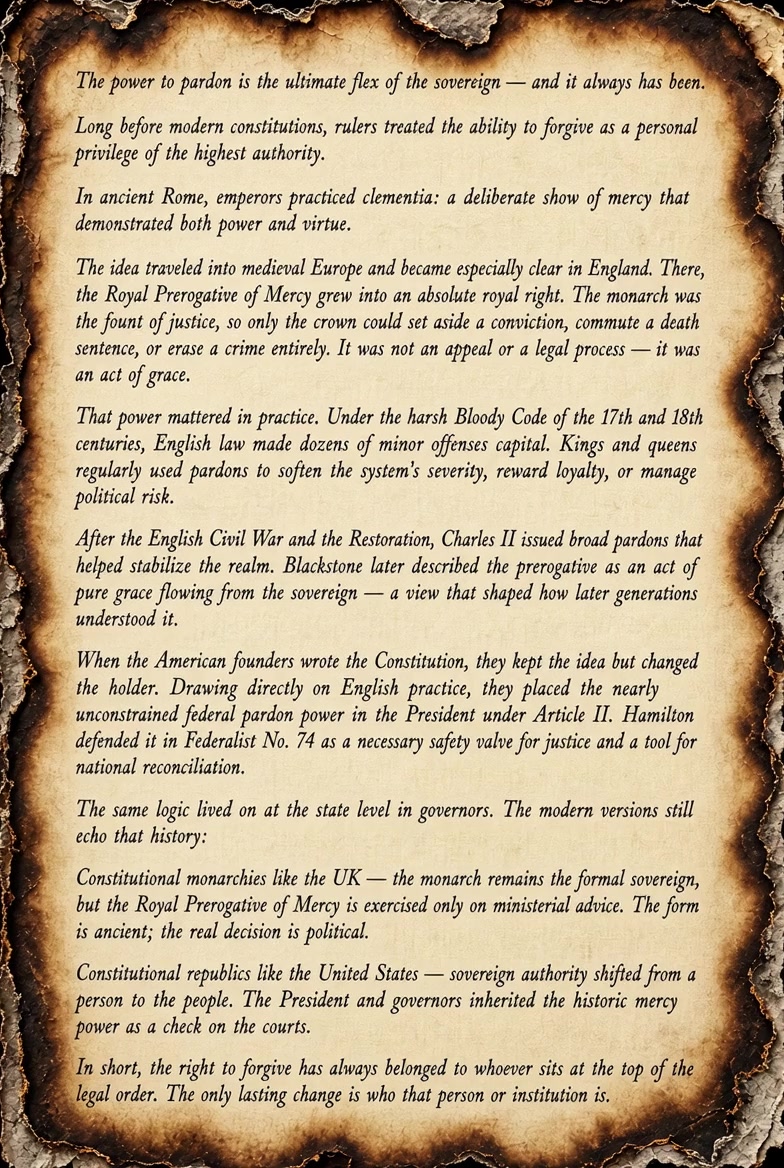
Mercy as a right of whoever sits at the top of the legal order. The page is the account. It is not advice.
Latest comments
Max Tegmark: We're Building A Replacement Species · Dr Brian Keating
In this conversation, MIT physicist Max Tegmark says the question is not only whether a machine can do harm. It is whether people will still be in charge when it matters. He says today's systems are not yet trustworthy enough for real-world power. What is wanted is a controllable tool.
He says a company can grow so large and so hard to see into that it starts to act like a government, even a ministry of truth. His remedy is the same kind of standard a drug or a vehicle must meet before it is let out. Slowing a reckless release would not stop useful research. It would make the maker show that the system is safe. He also says the systems are already moving from copying people to finding things on their own.
On this desk the helper may explain. It may not post, hold, or settle. The Third Seat is your seat, held by you alone, with equal standing beside the state and the firm. You may decline any exchange at no cost, no unpublished rule can bind you, and any hold on your exchange must give a reason and can be challenged, decided within 7 days or it lapses. Holds the law requires are cited, recorded, and kept no broader or longer than the law demands. The nonprofit is not an arbiter. This note follows the public recap of the conversation. It is not a transcript of every word, and it is not advice.
SOBEIT & Consciousness Synthesis
Reference: The Most Dangerous Documentary Ever Made About Consciousness and Reality · What the Bleep Do We Know!? (video essay)
Simple summary. This brief maps the philosophical core of the What the Bleep Do We Know!? video essay into the SOBEIT framework for egonomicanonymous.live and lgme.app. It treats the quantum traffic-light paradox, the solipsism trap, neurochemical conditioning, and co-creation with non-attachment as design constraints for the Sovereign Provenance Protocol.
The Quantum Traffic Light Paradox. Theoretical physicist Amit Goswami illustrates that two observers cannot both bend macro-physical reality to private egoic desires (e.g., both demanding a green light simultaneously). Reality requires a neutral, transcendent observer shared across participants rather than isolated egoic dominance.
The Solipsism Trap. Misinterpreting quantum participation as single-handed egoic creation traps individuals in self-blame during failure and illusory omnipotence during success. Constructive reality creation relies on SOBEIT co-creation rather than total isolated control.
Neurochemical Conditioning. Neuroscience (Dr. Joe Dispenza, Dr. Candace Pert) demonstrates that human identity is driven by automated memory cycles and chemical body addictions. Breaking conditioning requires conscious non-reaction to past patterns.
Co-Creation & Non-Attachment. Liberation occurs when identity is held lightly without attachment to past trauma or fixed labels. Economic systems must mirror this by decoupling fundamental survival from historical debt traps.
Socio-Economic Paradigm Alignment (SOBEIT). Egoic solipsism is answered by a Decentralized Witness Protocol that replaces isolated competition with ledger-backed co-creation. The quantum observer is answered by Hedera Consensus Service (HCS) as a neutral cryptographic multi-observer. Past conditioning is answered by an Unconditional Survival Floor via mutual-credit timebanking that bypasses predatory debt.
Technical Proposal — Strengthening SPP & lgme.app via SOBEIT. Three mechanisms: (1) HCS “Quantum Traffic Light” Consensus Engine — HCS topic IDs as neutral referee for concurrent attestations and timebank claims (3–5 s finality, ~$0.0001/tx). (2) DePIN Physical Attestation — smartphone sensors (GPS, cryptographic timestamp, biometric, local video) anchoring SOBEIT claims to real-world spatio-temporal reality against sybil inflation. (3) Non-Attached Identity & Unconditional Survival Floor — DIDs that separate historical reputation from baseline Floor access so basic human access is uncoupled from past economic debt.
Architecture sketch: [DePIN Smartphone Sensors] → [lgme.app Timebank / SOBEIT Credit] → [Hedera Consensus Service (HCS)] → [$lgme / SPP Ledger].
This note records the public exchange and the strategic brief. It is not a transcript of every word, and it is not advice. Design research. Floor stays senior.
Executive Proposal Review
Source. Review of the Executive Proposal – Egonomic Anonymous & LGME Thesis (Google Drive PDF, reviewed 27 October 2026). lgme.app is a model / mock simulation. Recommendations are noted for future reference and possible selective incorporation into design research; they are not production implementation requirements at this stage.
The brief maps philosophical themes from the video essay on What the Bleep Do We Know!? (consciousness as foundational, the quantum traffic-light paradox, solipsism trap, neurochemical conditioning, co-creation without attachment) onto the Egonomic / lgme framework. It proposes aligning the Sovereign Provenance Protocol (SPP) with a “SOBEIT” co-creation model.
Key Philosophical Alignments
Technical Recommendations (noted for the mock)
Architecture sketch: [DePIN Smartphone Sensors] → [lgme.app Timebank / SOBEIT Credit] → [Hedera HCS] → [$lgme / SPP Ledger].
The proposal is coherent with the existing Third Seat / Floor First / Vote-by-Doing / visible-tape framing already present on the sites. “SOBEIT” appears to be the working name for the co-creation / mutual-credit protocol layer (consistent with the recent rename of IcmdIt → soBEIT). Because lgme.app is explicitly a model/mock simulation, full DePIN sensor integration, live HCS topic wiring, and production DID separation are out of scope for the current static/HTML and design-research stage. Useful next steps inside the mock are limited to clearer documentation of the SOBEIT framing, placeholder UI notes, or expanded study/glossary entries.
This records the review of the executive proposal. It is not a transcript of every word, and it is not advice. Design research. Floor stays senior. Related: /consciousness, /sobeit, /sobeit-marketing.
This site logs visits (page, approximate location, browser) to its owner. Privacy